
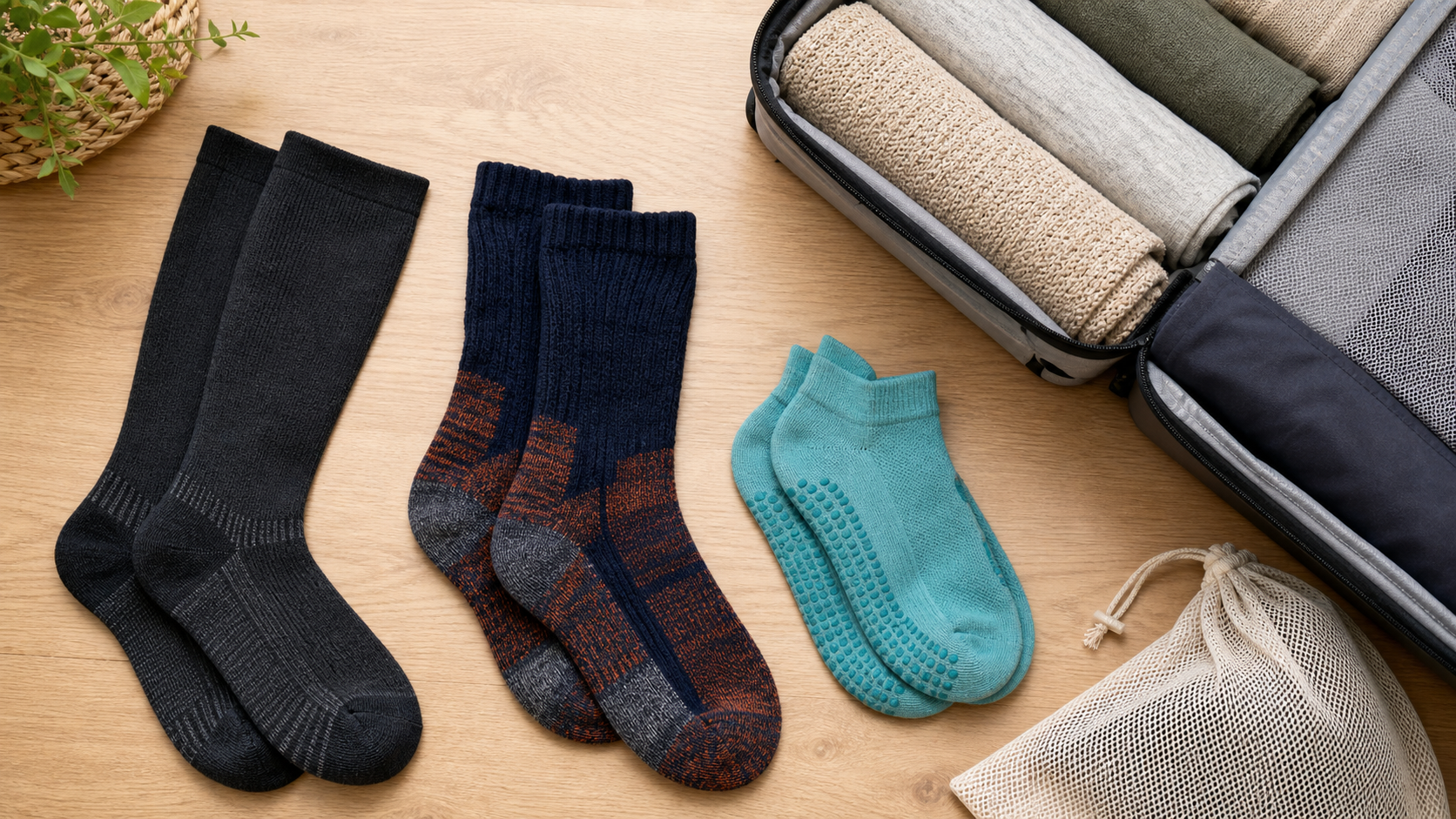
The short answer: compression socks, ski socks and aqua socks solve different packing problems. Compression styles are close-fitting leg garments whose suitability depends on the wearer and the product. Ski socks are designed to sit inside ski boots and manage warmth and bulk. Aqua socks are lightweight foot coverings for wet environments. One pair should not be assumed to replace another.
Choose from the exact product page, size chart, material label and care instructions. Product titles describe intended use, not guaranteed medical, thermal, waterproof or athletic performance.
Quick comparison
| Category | Pack it for | Fit priority | Care priority |
|---|---|---|---|
| Compression socks | Travel or activities when appropriate for you | Correct calf, ankle and length measurements; no painful pressure | Protect elasticity and follow the label |
| Ski socks | Ski boots and cold-weather days | Smooth, low-bulk fit without folds | Dry fully; use the stated wash temperature |
| Aqua socks | Beach, poolside or other permitted wet settings | Secure heel and toe fit without rubbing | Rinse and dry between uses |
1. Build the itinerary before the sock list
Write down the actual activities, expected temperatures, footwear and access to laundry. A city flight, a day in ski boots and a rocky shoreline require different layers. For a mixed trip, pack by use rather than trying to find one universal pair.
The Winter Ski Socks – Wool Blend for Cold Weather Comfort are a ski-specific listing. The Quick Aqua Dry Socks and Printed Aqua Socks are separate wet-use listings. Review their current variants and descriptions before ordering; similar category names do not prove identical construction.
2. Treat compression as a fit and health decision
Start with the manufacturer’s measurement method, not your ordinary shoe size alone. Measure at the recommended time and locations, commonly around the ankle and calf and sometimes leg length. Fabric should lie smoothly, without bunching, a rolled top band or concentrated pressure.
The Durable High Length Compression Socks and Sports Compression Socks are distinct active listings. Their names do not establish a clinical compression level or medical suitability. Verify any stated compression strength, sizing and directions on the live page and package.
Compression socks are not a self-prescribed treatment. Ask a qualified clinician before use if you have circulation problems, reduced sensation, skin wounds, unexplained swelling or another relevant medical condition, or if a clinician has previously advised against compression. The CDC advises travellers at increased risk of blood clots to discuss prevention with a doctor. Movement and hydration plans should follow appropriate public-health and clinical advice.
Remove the socks and seek appropriate advice for new pain, numbness, tingling, marked colour change, cold skin, worsening swelling, breathing difficulty or chest pain. The guide cannot diagnose a symptom or promise improved circulation, clot prevention or athletic recovery.
3. Fit ski socks to the boot, not to a warmth myth
A ski sock should lie flat from toes to cuff. Extra-thick fabric is not automatically warmer inside a close boot; excessive bulk can alter boot fit and create pressure. Test the intended socks with the actual boots, liners and footbeds before departure.
Check that toes can move, the heel stays seated and no seam or fold forms beneath a buckle. Carry a dry spare if the itinerary makes that practical. Cold-weather safety depends on conditions, footwear, activity and the person—not a sock title. Leave the slope and warm up if feet become numb, unusually pale, waxy or painful.
4. Use aqua socks within their limits
Aqua socks can add a lightweight layer between feet and some surfaces, but they are not automatically waterproof, puncture-proof, slip-proof or suitable for every current, reef, pool deck or trail. Check local rules and site hazards. Never use product footwear as a substitute for swimming ability, supervision or a personal flotation device where one is required.
Try the aqua socks dry first. The heel should stay in place and toes should not press hard against the front. Then test them in a controlled setting because fit can feel different when wet. Stop if grit, seams or movement causes rubbing. Sharp objects can penetrate many flexible soles, and traction varies by surface.
5. Pack clean and used pairs separately
Use a breathable pouch for dry clean socks and a separate washable bag for used pairs. Do not seal damp socks in luggage for longer than necessary. If you must pack before they are dry, isolate them temporarily, then unpack, rinse or wash and dry them as soon as possible.
A simple mixed-trip plan is one activity pair in use, one dry spare for high-use days and enough ordinary socks for the remaining footwear. The right quantity depends on trip length and laundry access; buying a large pack is not automatically the lighter or more sustainable choice.
6. Follow the textile care label
Turn to the sewn-in label and current product instructions for water temperature, detergent, bleaching, machine drying and ironing. Canada’s Competition Bureau explains that textile labels identify fibre content and dealer information. Fibre blends and elastics vary even within one category, so a single wash routine cannot be guaranteed for every Sockz product.
Fasten any closures on other laundry, use a mesh bag when recommended and avoid direct high heat unless the label permits it. Rinse aqua socks after saltwater or chlorinated-water use when the manufacturer directs, then open them fully to air-dry. Let ski socks dry before repacking. For compression socks, avoid stretching the cuff aggressively while putting them on or taking them off.
A two-minute pre-trip audit
- Open each live product page and confirm the current variant, size and care directions.
- Try each pair with its intended footwear.
- Walk, sit and bend; reject painful pressure, folds or heel movement.
- Confirm that compression is appropriate for you, seeking clinician input when needed.
- Pack a breathable clean-sock pouch and a separate used-pair bag.
- Do not rely on waterproof, slip-proof, circulation or performance guarantees.
Frequently asked questions
Can I use ski socks as compression socks?
Do not assume so. A snug ski sock is not necessarily a medically graded compression garment. Use the exact specifications and qualified guidance relevant to your needs.
Are aqua socks waterproof?
No blanket claim is appropriate. Many are meant to get wet and drain or dry; check the exact listing. They do not guarantee dry feet or protection from every hazard.
Should I wear two pairs of ski socks?
Only if the boot maker and your fit professional support that setup. Extra layers can create bulk, folds and pressure. Test the complete boot system before travel.
Can compression socks prevent a travel blood clot?
This article makes no prevention claim. Risk varies by person. Follow CDC guidance and ask a clinician about measures appropriate for you, especially if you have risk factors.
How should wet aqua socks be packed?
Keep them separate from clean clothing only temporarily, then rinse or wash as directed and dry fully. Do not leave damp textiles sealed in luggage.
Bottom line
Pack compression, ski and aqua socks as separate tools. Match each pair to the activity, exact footwear, measurements and care label. A successful travel kit is not the one with the most claims—it is the one that fits comfortably, dries and stores responsibly, and respects medical and environmental limits.