
Winter Ski Socks in October: Check Boot Volume Before the First Cold Trip
Put these socks into the exact ski or winter boots you will travel with and reject the combination if normal closure or toe room no longer works for you. “Ski” and “winter” identify the intended category, but they do not prove compatibility with every boot or temperature.
Begin with the documented pair
Winter Ski Socks – Wool Blend for Cold Weather Comfort is listed as an 80% wool and 20% polyester four-pair pack in sizes S, M, L and XL. The page instructs machine washing cold, air drying and no bleach. Those are useful ownership facts; its warmth, moisture, arch-support and fatigue language should not be converted into a timed warmth, circulation or medical promise.
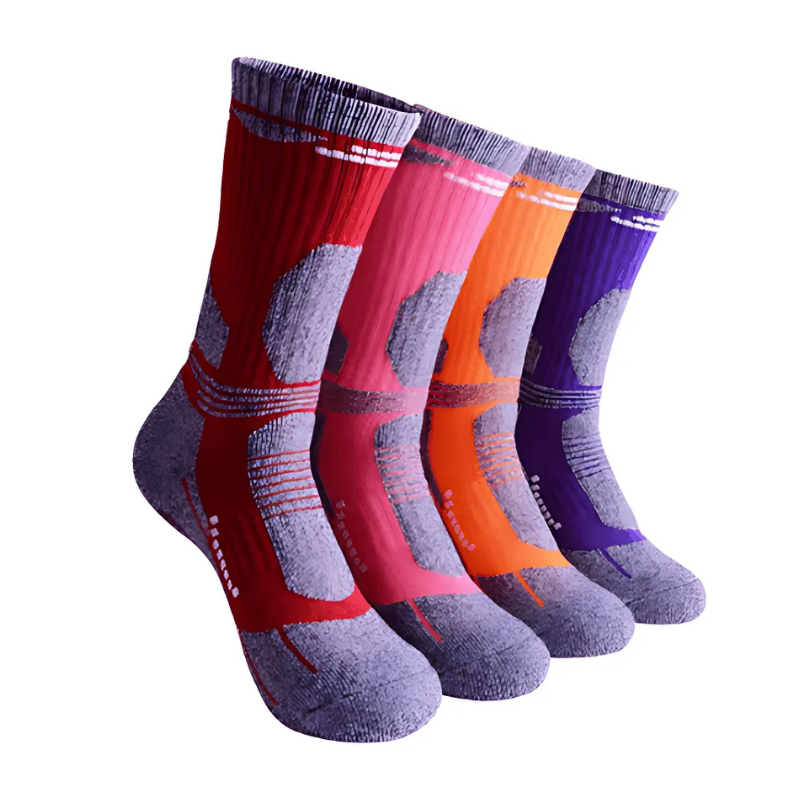
The lace-or-buckle comparison
Try one boot first with the ordinary sock you already use. Note the usual lace eyelet, buckle notch or closure position. Switch to the Winter Ski Socks, put the same boot on, and close it normally—without loosening beyond a position you would accept on the trip. Stand, sit and walk briefly indoors.
| Observation | What it means |
|---|---|
| Toes can move as usual; closure stays at its normal position | The volume check passes for this wearer and boot. |
| Closure needs a major change or the foot feels crowded | Use a different sock or boot combination. |
| Bunching appears at heel or toe | Recheck size and placement; do not rely on the category name. |
Travel quantity from the four-pair pack
For a three-day trip, one wearer could assign one pair per planned day and keep the fourth as a clean backup, subject to the actual activity and laundry plan. That is an inventory example, not advice to wear a pair for a fixed number of hours.
After the test, follow the listed cold-wash and air-dry directions. The only fit conclusion belongs to the person, sock size and boot that were actually tried together.