
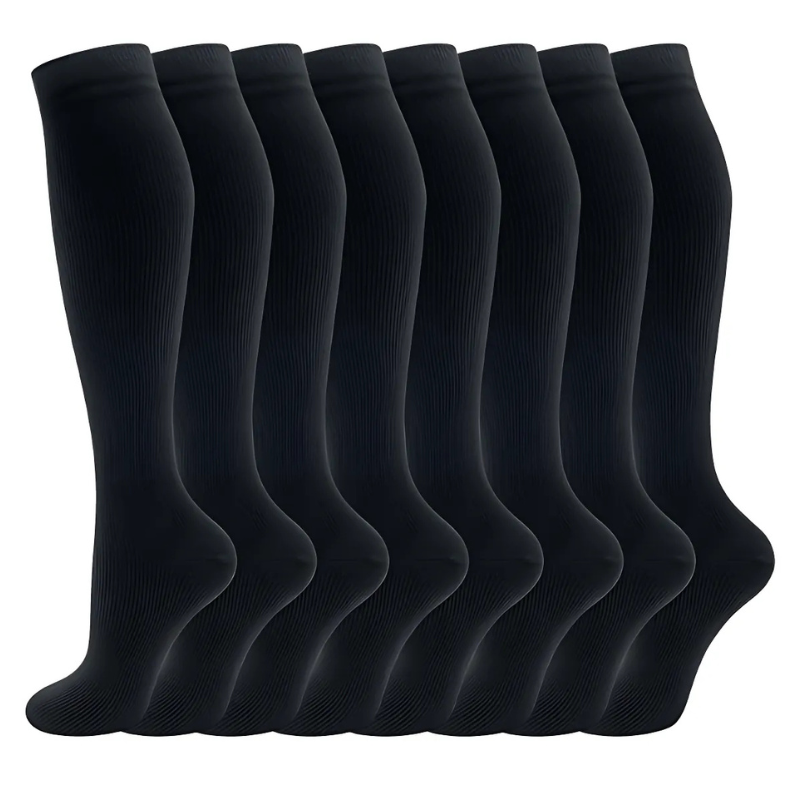
Quick answer: Replace everyday socks when holes, thin spots, slipping or flattened cushioning make them uncomfortable or ineffective for their intended use. Fading or surface bobbles alone do not establish failure. Check each pair; you do not need to discard a whole pack because one pair is worn.
Socks are one of the few wardrobe items nobody inspects closely until there's a hole in one. Here are the actual signs worth watching for, and a simpler way to think about replacing them than "wait until they fail."
The wear signs that actually matter
- Thinning at the heel and toe. These are the highest-friction points in any sock. When the fabric there starts to feel thin or slightly see-through, the sock is on its way out even if the rest still looks fine.
- A sock that repeatedly slips or bunches. Check that it is the correct size and has been washed according to its label. Persistent slipping can be a reason to replace it, but it is not a measurement of compression pressure.
- Surface bobbles with another problem. Check beneath the pilling for holes or thinning and notice whether the surface rubs inside your shoe. Do not treat appearance alone as a reason to replace a comfortable, intact everyday pair.
- Loss of cushioning. Sports and athletic socks are built with cushioned zones at the ball and heel of the foot. Once that padding compresses permanently and doesn't spring back, the sock isn't doing its original job anymore even without a visible hole.
- Fit changes that persist after washing. A twisted heel, stretched shape or uncomfortable seam matters more than a change in colour. Fading cannot tell you whether a compression garment still delivers its stated pressure.
Why rotation matters as much as replacement
A sock that's washed and worn every single day wears out faster than one from a larger rotation, simply because it's absorbing more total wear cycles per month. Owning enough pairs to rotate through — rather than relying on the same 3 or 4 pairs on repeat — is one of the simplest ways to extend how long any individual pair lasts before it hits the wear signs above.
Calculate your rotation from laundry, not pack size
Count how many fresh pairs you use between loads being washed and fully dry. Add pairs for exercise or other changes, then a small spare allowance that suits you. For example, seven days of one fresh pair daily plus two workout changes means nine pairs before spares. Five or six pairs cannot cover that routine without an earlier wash.
A larger rotation spreads wear across more pairs; it does not prove a longer total service life for each pair. Buy enough for the routine you actually have.
Compression and diabetic socks need a separate check
Do not judge prescribed compression by colour, cuff tightness or a home stretch test. Follow the replacement interval for the specific garment and your clinician’s instructions. Kingston and Richmond NHS guidance describes replacement every three to six months depending on the make; this is not a universal lifespan for every retail sock.
A non-binding sock is not interchangeable with a compression stocking. New pressure marks, swelling, discomfort or a change in fit should not simply be blamed on an old sock. Ask your care team about changes, especially if you have diabetes, reduced sensation or prescribed compression. This guide cannot determine the right pressure or treatment for you.
A simple keep, repair or replace check
Sort clean, dry pairs while folding laundry. Keep intact pairs that fit; set aside an everyday pair with a small repairable hole if you are comfortable mending it; replace pairs with widespread thinning, persistent slipping or uncomfortable seams. Do not darn or alter a prescribed compression garment without professional advice. If a pack is all the same age, inspect it together rather than discarding it automatically.
Frequently asked questions
How long should everyday socks last?
There is no useful universal deadline. Activity, footwear, material, fit and care all vary. Judge condition and comfort rather than an arbitrary number of months.
Should I replace a whole pack at once?
Only if the individual pairs need replacement. Keeping usable pairs avoids unnecessary waste.
Can I tell compression strength by how tight a sock feels?
No. Follow the manufacturer’s replacement guidance and your clinician’s fit checks rather than using sensation as a pressure test.
More from the Sockz blog
- A buyer's guide to sock multi-packs
- 8-Pack High Length Compression Socks — a closer look
- How to pick your compression sock size
- Shop compression socks
Prices are current as of publication and may change — see each product page for the latest details. This article is general information, not medical advice — consult your care team about compression or diabetic sock needs specific to you.